
Holiday Lets and Tax: A Clear Guide for UK Property Owners
28 November, 2025
Introduction to Holiday Rental Taxation
The holiday accommodation sector has witnessed substantial growth in recent years, with property owners increasingly recognizing the financial benefits of short-term rentals. However, the tax implications of operating holiday lets can be complex and multifaceted. Property owners must navigate a specialized tax landscape that differs significantly from long-term residential lettings or standard property ownership. Understanding the taxation framework applicable to holiday rentals is crucial for compliance and optimal financial planning. This comprehensive guide explores the key tax considerations, potential advantages, and compliance obligations for individuals operating holiday lets in the UK, providing essential knowledge for property investors seeking to maximize returns while remaining fully compliant with UK tax legislation.
Furnished Holiday Lettings (FHL) Status: The Cornerstone of Holiday Let Taxation
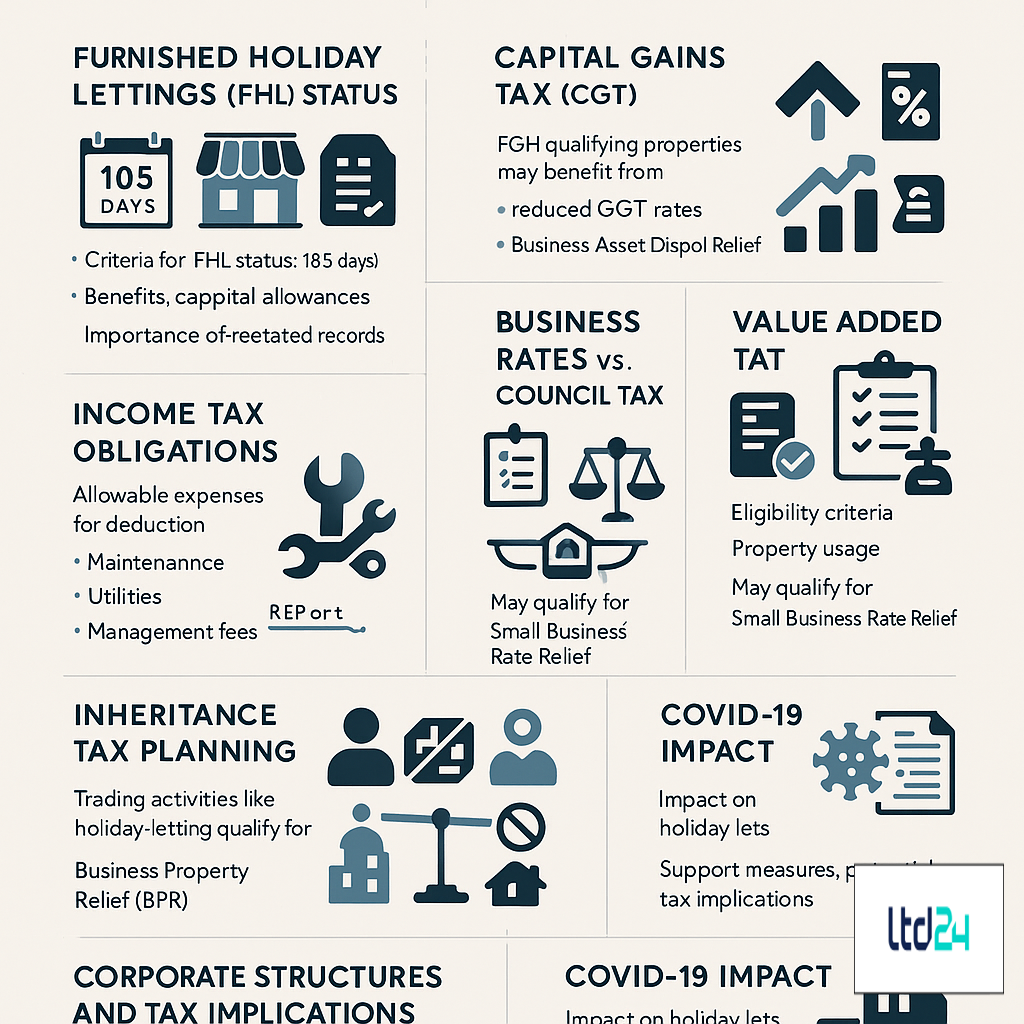
Furnished Holiday Lettings (FHL) status represents a distinctive tax classification in the UK tax system, offering several significant advantages to qualifying property owners. To achieve FHL status, a property must meet specific criteria established by HM Revenue & Customs (HMRC). These requirements include availability for commercial letting for at least 210 days per year, actual commercial occupation for a minimum of 105 days, and no single occupancy exceeding 31 consecutive days for more than 155 days during the relevant period. Properties with FHL status benefit from preferential tax treatment, including capital allowances for furniture and fixtures, ability to claim mortgage interest as a business expense, and potential eligibility for Business Asset Disposal Relief (formerly Entrepreneurs’ Relief) on property sale. Securing and maintaining FHL classification requires meticulous record-keeping and strategic letting management, as evidenced in cases where property owners have lost valuable tax reliefs due to falling short of the occupancy thresholds by minimal margins. For comprehensive guidance on FHL qualification, property owners should consult the detailed HMRC guidelines or seek specialized advice from tax professionals.
Income Tax Obligations for Holiday Let Proprietors
Holiday let owners must accurately report rental income on their annual Self Assessment tax return, typically using the UK Property pages or, for FHL-qualifying properties, the dedicated Furnished Holiday Lettings section. The taxable profit is calculated by deducting allowable expenses from the gross rental income received during the tax year. Allowable expenses encompass a range of operational costs, including property maintenance, utility bills, insurance premiums, cleaning services, property management fees, and marketing expenditures. For properties with FHL status, mortgage interest remains fully deductible as a business expense, representing a significant advantage compared to long-term residential lettings where mortgage interest relief has been restricted to the basic rate tax credit. Holiday let owners should maintain comprehensive financial records, organized by tax year, documenting all income and expenditure with supporting evidence such as invoices and receipts. This meticulous record-keeping is essential for accurate tax reporting and provides necessary documentation in the event of an HMRC inquiry. Individuals operating multiple holiday properties should consider implementing dedicated accounting software to facilitate efficient financial management and streamlined tax compliance. For tailored advice regarding income tax obligations specific to holiday lets, consulting with a UK tax advisor is highly recommended.
Capital Gains Tax Considerations for Holiday Let Properties
When disposing of a holiday rental property, owners may face Capital Gains Tax (CGT) liabilities on any appreciation in value since acquisition. However, properties qualifying as Furnished Holiday Lettings enjoy distinct advantages regarding CGT treatment. FHL-qualifying properties may be eligible for Business Asset Disposal Relief (BADR), potentially reducing the applicable CGT rate from 28% to 10% on gains up to the lifetime limit of £1 million. Additionally, owners may utilize Rollover Relief to defer CGT liabilities when reinvesting proceeds into another qualifying business asset. For holiday lets not meeting FHL criteria, standard residential property CGT rates apply—18% for basic rate taxpayers and 28% for higher or additional rate taxpayers, after deducting the annual CGT allowance. Strategic timing of property disposal can significantly impact tax liabilities; for instance, selling in a tax year when other income is lower might result in a portion of the gain being taxed at the lower 18% rate. Property improvements that enhance capital value, such as extensions or significant renovations, can be added to the property’s cost basis, potentially reducing the taxable gain upon disposal. Property owners contemplating sale should maintain comprehensive records of all capital improvements to substantiate increased acquisition costs for CGT calculations. For complex CGT scenarios involving holiday lets, particularly those with mixed-use periods or partial qualification for FHL status, seeking specialized advice from tax planning professionals is highly recommended.
Value Added Tax (VAT) Implications for Holiday Let Operations
Holiday let operations may trigger Value Added Tax obligations when annual taxable turnover exceeds the VAT registration threshold, currently set at £85,000. Unlike long-term residential lettings, which are exempt from VAT, holiday accommodations are classified as short-term commercial lets subject to standard rate VAT (currently 20%). VAT registration requirements apply not only to the property rental income but encompass all taxable supplies, including additional services such as cleaning fees, breakfast provision, or equipment rentals. Property owners approaching the VAT threshold must monitor their rolling 12-month turnover diligently, as failure to register when required can result in substantial penalties and retrospective VAT liabilities. Once VAT-registered, owners must charge VAT on their holiday let income, submit quarterly VAT returns, and maintain VAT-compliant records and invoices. However, VAT registration also permits recovery of input VAT on eligible business expenses, including property repairs, maintenance, and operational costs. For holiday let owners operating multiple properties or providing additional services, the Flat Rate Scheme might offer administrative simplification and potential tax advantages. Property owners contemplating significant renovation projects should consider VAT implications before commencement, as substantial refurbishment work may qualify for the reduced 5% VAT rate under specific circumstances. For comprehensive guidance on VAT obligations and opportunities relevant to holiday lets, consulting with a specialized VAT advisor is strongly recommended, particularly for complex scenarios involving mixed-use properties or extensive renovation projects.
Business Rates vs. Council Tax: Local Taxation Considerations
Holiday let properties in England are subject to business rates rather than council tax when classified as self-catering accommodations "available for commercial letting for short periods totaling 140 days or more per year." This classification represents a significant consideration for property owners, as the financial implications can vary substantially depending on individual circumstances. Properties qualifying for business rates may benefit from Small Business Rate Relief, potentially reducing or eliminating the local tax liability for properties with a rateable value below £15,000. Conversely, properties not meeting the 140-day availability threshold remain subject to council tax, typically including a second-home premium in many local authority areas. The determination between business rates and council tax carries additional significance beyond direct tax liabilities, as it influences eligibility for certain grants and reliefs. For instance, during the COVID-19 pandemic, holiday let properties registered for business rates qualified for specific support schemes unavailable to properties under the council tax regime. Property owners should conduct thorough financial modeling comparing the implications of both taxation systems for their specific circumstances, considering factors such as property value, local authority policies, and available reliefs. The assessment process involves application to the Valuation Office Agency with supporting evidence demonstrating commercial letting patterns. For properties spanning multiple tax years with varying usage patterns, transitioning between business rates and council tax may be necessary, requiring proactive communication with relevant authorities. Given the potential financial significance and administrative complexity, seeking professional advice regarding optimal local taxation strategies for holiday let properties is highly recommended, particularly when considering new property acquisitions or significant changes to existing letting patterns.
Inheritance Tax Planning for Holiday Let Properties
Holiday let properties present distinctive inheritance tax (IHT) planning opportunities, particularly for those qualifying as Furnished Holiday Lettings. Unlike standard investment properties, FHL-qualifying accommodations may potentially benefit from Business Property Relief (BPR), which can provide up to 100% relief from inheritance tax. However, securing this valuable relief requires demonstrating that the holiday let operation constitutes a genuine trading business rather than a passive investment activity. HMRC applies stringent criteria when assessing BPR eligibility for holiday lets, examining factors such as the level of additional services provided, operational involvement, and the overall business character of the enterprise. Case law in this area, notably the Pawson case (HMRC v Pawson [2013] UKUT 50), has established challenging precedents, emphasizing that merely providing self-catering accommodation typically represents an investment activity rather than a trading business. Property owners seeking BPR must provide substantial evidence of active business operations exceeding basic property rental, such as offering regular cleaning services, welcome packages, concierge assistance, or organized activities. Effective inheritance tax planning for holiday let properties necessitates comprehensive documentation of all additional services provided, operational involvement, and business development activities. Strategic structuring of holiday let ownership, potentially utilizing family partnerships or certain trust arrangements, may enhance IHT efficiency when implemented appropriately. Given the complex and evolving nature of BPR qualification for holiday lets, property owners should engage specialized inheritance tax planning advisors to develop robust strategies aligned with current HMRC interpretations and relevant case law.
Operating Through Corporate Structures: Tax Implications
Establishing a limited company for holiday let operations presents alternative tax considerations compared to direct individual ownership. Corporate structures incur Corporation Tax on profits, currently at 25% for companies with profits exceeding £250,000 (with a tapered rate for profits between £50,000 and £250,000). This corporate rate may prove advantageous compared to higher personal income tax rates of 40% or 45% for substantial holiday let profits. Limited companies permit full deductibility of mortgage interest as a business expense without the restrictions applying to individual landlords, potentially enhancing cash flow and overall profitability. However, extracting profits from the company may trigger additional tax liabilities through salary (subject to income tax and National Insurance contributions) or dividends (taxed at rates of 8.75%, 33.75%, or 39.35% depending on income tax band). Property transfers into corporate structures typically constitute a disposal for Capital Gains Tax purposes and may trigger Stamp Duty Land Tax liabilities, creating significant establishment costs. Companies lose access to the individual Capital Gains Tax annual exempt amount and may face higher Stamp Duty Land Tax rates on property acquisitions due to the corporate rate surcharge. Additionally, corporate ownership eliminates potential eligibility for Furnished Holiday Letting status benefits specific to individual taxpayers. Strategic corporate planning requires comprehensive modeling of long-term financial projections, considering factors such as anticipated rental profits, property appreciation, intended holding period, and ultimate exit strategy. For holiday let portfolios of substantial value or generating significant income, corporate structures may offer compelling advantages despite the increased administrative requirements. Property owners contemplating incorporation should seek specialized tax advisory services to conduct detailed comparative analysis of available ownership structures based on their specific circumstances and objectives.
HMRC Compliance and Record-Keeping Requirements
Maintaining comprehensive documentation and adhering to HMRC compliance obligations is fundamental for holiday let operators. Property owners must retain complete financial records for a minimum of six years, including rental income, expense receipts, booking details, and occupancy patterns. These records serve multiple critical purposes, including accurate tax return preparation, substantiation of FHL status qualification, evidence for expense deductibility, and documentation for potential HMRC inquiries. Digital record-keeping systems have become increasingly important following the introduction of Making Tax Digital (MTD) requirements, which mandate digital maintenance of VAT records for businesses exceeding the registration threshold. Essential documentation encompasses property acquisition and improvement costs, mortgage statements, insurance policies, utility bills, maintenance invoices, marketing expenses, and comprehensive letting details including dates, duration, and income for each booking. Property owners should implement robust systems for tracking availability and occupancy periods, as these metrics directly impact FHL status qualification and associated tax advantages. Regular reconciliation of financial records against bank statements helps identify potential discrepancies or omissions before tax filing deadlines. HMRC has demonstrated increasing scrutiny of the holiday let sector, conducting targeted compliance campaigns examining issues such as undisclosed rental income, inappropriate expense claims, and improper FHL classification. Property owners facing HMRC inquiries without adequate supporting documentation may encounter significant challenges defending their tax positions, potentially resulting in additional tax assessments, interest charges, and penalties. Given these complexities, many holiday let operators engage professional accounting services specializing in property taxation to ensure comprehensive compliance with evolving regulatory requirements.
International Taxation Considerations for Overseas Holiday Lets
Property owners with holiday lets in foreign jurisdictions face complex tax considerations spanning multiple tax systems. UK residents owning overseas holiday properties must report foreign rental income on their UK Self Assessment tax returns, regardless of whether tax has been paid locally in the property’s jurisdiction. The UK maintains double taxation agreements with numerous countries to prevent dual taxation of the same income, typically through foreign tax credits offsetting UK tax liabilities by the amount of foreign tax already paid. However, calculating these credits often involves intricate adjustments and currency translations. Property owners should note that overseas properties cannot qualify for UK Furnished Holiday Letting status, regardless of meeting equivalent operational criteria; however, European Economic Area properties meeting the standard FHL conditions may qualify for similar tax treatment. Capital gains on overseas property disposals are subject to UK Capital Gains Tax for UK residents, though the computation may differ from domestic property calculations and must account for any foreign tax paid on the same gain. Inheritance tax considerations for international holiday lets are particularly complex, as properties may be subject to estate taxes in both the UK and the jurisdiction where the property is located, with varying relief mechanisms depending on the relevant double taxation treaty. For non-UK domiciled individuals, careful structuring of overseas holiday let ownership may provide tax efficiency, particularly when considering the remittance basis of taxation. Currency fluctuations introduce additional complexity, as exchange rate movements may create taxable gains or allowable losses distinct from the property’s actual performance in local currency. Given the multifaceted nature of international property taxation, owners of overseas holiday lets should engage tax advisors with cross-border expertise to ensure comprehensive compliance with all relevant jurisdictions while implementing effective tax efficiency strategies.
Tax-Efficient Mortgage and Financing Structures
Implementing optimal financing arrangements for holiday let properties can significantly enhance after-tax returns. For properties qualifying as Furnished Holiday Lettings, mortgage interest remains fully deductible as a business expense, contrasting favorably with conventional buy-to-let properties where interest relief is restricted to the basic rate tax credit. Property owners should carefully evaluate various financing options, considering factors such as fixed versus variable interest rates, repayment versus interest-only structures, and potential for offset mortgage arrangements. Strategic allocation of financing between multiple properties can optimize tax efficiency, particularly when portfolio includes both FHL-qualifying properties and standard rental investments. Refinancing existing holiday let properties to release equity for additional property acquisitions may create tax-efficient expansion opportunities, effectively leveraging FHL tax advantages across a growing portfolio. Property owners should maintain detailed records of all financing costs, including mortgage arrangement fees, valuation expenses, and legal costs associated with property financing, as these may qualify as allowable deductions or capital expenditure depending on their nature. For substantial holiday let portfolios, exploring commercial lending options may provide advantageous terms compared to standard residential buy-to-let mortgages, particularly when the properties demonstrate strong commercial performance. When utilizing company structures for holiday let ownership, corporate financing arrangements typically offer different terms and considerations compared to individual borrowing, requiring specialized evaluation. Given the significant impact of financing structures on overall investment returns, holiday let owners should regularly review existing arrangements against current market offerings and evolving tax legislation. For comprehensive financing optimization, consultation with both mortgage specialists familiar with holiday let criteria and tax advisors understanding the taxation implications is highly recommended.
Tax Relief for Property Improvements and Renovations
Strategic investment in property improvements can enhance both commercial appeal and tax efficiency for holiday let owners. For properties with FHL status, capital expenditure on furniture, fixtures, and equipment qualifies for Annual Investment Allowance (AIA), potentially providing immediate tax relief up to the current annual limit of £1 million. This contrasts favorably with standard rental properties where such expenditure typically receives more restricted relief through the Replacement Domestic Items relief. Qualifying expenditures for capital allowances include furniture, kitchen appliances, air conditioning systems, bathroom installations, and integrated security systems. Property owners should maintain comprehensive documentation for all capital improvements, including invoices, payment records, and photographic evidence, establishing both the nature and timing of the expenditure. Structural alterations and significant property enhancements that increase the capital value, such as extensions or loft conversions, typically do not qualify for immediate tax relief but instead adjust the property’s cost basis for future Capital Gains Tax calculations. Strategic timing of major renovations can optimize tax relief, particularly when scheduled during periods of lower rental income or when spanning multiple tax years to maximize allowance utilization. Holiday let owners undertaking substantial property refurbishments should consider potential VAT implications, as certain renovation projects may qualify for reduced-rate VAT under specific circumstances. For properties owned through limited companies, different capital allowance rules may apply, potentially offering enhanced relief opportunities compared to individual ownership structures. Given the technical distinctions between repairs (immediately deductible against rental income) and improvements (capital expenditure with different tax treatment), holiday let owners should consult with property tax specialists when planning significant property investments to ensure optimal classification and maximum legitimate tax relief.
Tax Planning Strategies for Holiday Let Investors
Implementing proactive tax planning strategies can substantially enhance the financial performance of holiday let investments. Effective tax optimization begins with thorough analysis of property ownership structures, considering options such as individual ownership, joint ownership between spouses or civil partners, partnership arrangements, or corporate structures based on specific circumstances and objectives. Strategic timing of income and expenditure can significantly impact tax liabilities; for instance, accelerating maintenance expenses into tax years with higher income or deferring rental receipts across tax year boundaries where appropriate. Utilization of pension contributions can reduce taxable income while building retirement assets, particularly beneficial for higher-rate taxpayers with substantial holiday let profits. For married couples or civil partners, allocating property ownership percentages to maximize use of individual tax allowances and lower rate bands can enhance overall family tax efficiency. Property owners approaching retirement might consider phased transition strategies, potentially converting holiday lets to main residences for a period to utilize Principal Private Residence relief before eventual disposal. Strategic assessment of FHL qualification across multiple properties allows focused management attention on properties near qualification thresholds, potentially reallocating marketing resources to maintain advantageous tax status across the portfolio. For owners with international mobility, careful consideration of residency and domicile status can significantly impact taxation of holiday let investments, particularly for non-UK properties. Given the complexity of holiday let taxation and the substantial financial implications of different strategies, investors should engage specialized tax planning professionals for personalized guidance tailored to their specific portfolio characteristics, financial circumstances, and long-term objectives.
Digital Platforms and Tax Compliance
The proliferation of online booking platforms such as Airbnb, Vrbo, and Booking.com has transformed holiday let marketing while introducing specific tax compliance considerations. Property owners utilizing digital platforms must understand that these platforms increasingly share rental income data directly with tax authorities through initiatives such as the OECD’s Mandatory Disclosure Rules and the EU’s DAC7 directive. This automatic information exchange significantly enhances HMRC’s visibility of rental income, making accurate and complete reporting increasingly important. Platform-specific documentation requirements include maintaining comprehensive records of all bookings, fees, and commissions charged by each platform, ensuring accurate calculation of taxable rental income. Different platforms implement varying commission structures and payment mechanisms, requiring careful reconciliation against bank statements to ensure complete income reporting. Property owners should establish robust systems for tracking cross-platform bookings to prevent duplication or omission when calculating total occupancy days for FHL qualification purposes. Many digital platforms default to calendar-year reporting while UK tax years run April to April, necessitating careful period adjustment when preparing Self Assessment returns. Some platforms offer specific tax summaries or earning statements, but these may not align perfectly with UK tax reporting requirements, requiring supplementary record-keeping. Platform-specific features, such as Airbnb’s "Smart Pricing" or cleaning fee options, may have distinct tax treatment requiring appropriate classification as rental income or service provision. Property owners utilizing multiple booking channels should consider specialized software solutions that consolidate bookings across platforms, simplifying income tracking and occupancy calculations for tax purposes. Given the evolving regulatory landscape surrounding digital platforms, holiday let owners should regularly review platform terms and conditions regarding data sharing with tax authorities and adjust compliance strategies accordingly. For comprehensive guidance on digital platform tax implications, consulting with accountants specializing in the sharing economy is highly recommended.
COVID-19 Impact and Tax Relief Measures
The pandemic substantially disrupted the holiday let sector, triggering various government support measures with significant tax implications. Property owners who received COVID-19 support grants, such as Self-Employment Income Support Scheme payments or local authority grants for businesses affected by restrictions, must include these grants as taxable income on their Self Assessment returns. However, the tax treatment varies depending on the specific grant program and business structure. For properties affected by booking cancellations or mandatory closures, owners faced challenges maintaining FHL status qualification. In response, HMRC introduced limited flexibility in the application of occupancy tests, including the "Period of Grace" election allowing properties that met the occupancy requirements in previous years to maintain FHL status temporarily despite falling short during the pandemic. Property owners should maintain detailed records of all COVID-related cancellations, refunds processed, and periods of mandatory closure to substantiate claims for tax relief or qualification exceptions. The pandemic accelerated shifts in holiday let market dynamics, with increased domestic demand and changing booking patterns that may have long-term implications for tax planning strategies. Properties repurposed temporarily during the pandemic, such as those offered to essential workers or healthcare staff, may face complex classification issues spanning multiple tax categories. Business interruption insurance payouts received due to pandemic restrictions have specific tax treatment that may differ from standard rental income. For holiday let owners who diversified into alternative income streams during travel restrictions, such as providing longer-term accommodations or different services, careful segregation of income sources is essential for accurate tax reporting. While many temporary COVID support measures have concluded, their impact continues to influence financial positions and tax calculations, particularly for loss carry-forward provisions and property valuation considerations. Holiday let owners navigating pandemic-related tax complexities should consult with tax professionals familiar with the specific relief measures and their interaction with standard holiday let taxation.
Future Tax Considerations and Legislative Changes
Holiday let owners must remain vigilant regarding evolving tax legislation that may impact their investments. Recent and anticipated changes warrant close attention, including potential Capital Gains Tax reform, with possible rate increases or allowance reductions that could significantly affect property disposal profitability. The government has signaled increased scrutiny of holiday let properties claiming business rates advantages without genuine commercial letting activity, potentially tightening qualification criteria for business rates versus council tax determinations. Legislative developments concerning mortgage interest relief for residential landlords have created a comparative advantage for FHL properties, but this disparity could attract future policy attention. The ongoing implementation of Making Tax Digital (MTD) will eventually extend to income tax, requiring digital record-keeping and quarterly reporting for all property income, necessitating preparation of appropriate systems and processes. Environmental considerations are increasingly influencing property taxation, with potential future incentives for energy-efficient holiday accommodations or additional levies on properties with poor environmental performance. The tax treatment of mixed-use properties combining holiday letting with personal usage faces ongoing refinement through case law and HMRC guidance, requiring careful monitoring by owners of such properties. International tax coordination initiatives, such as the OECD’s global minimum tax proposals, may eventually influence cross-border property investment structures and offshore holding arrangements. Regional devolution of tax powers within the UK creates potential for divergent holiday let taxation approaches across England, Wales, Scotland, and Northern Ireland, requiring multi-jurisdiction awareness for property portfolios spanning these regions. Given these evolving considerations, holiday let investors should establish relationships with tax advisors specializing in property taxation, schedule regular tax planning reviews, and maintain membership in relevant industry associations to access timely updates on legislative developments affecting holiday let investments.
Expert Guidance for Your Holiday Let Tax Strategy
Navigating the complex tax landscape of holiday lets requires specialized knowledge and proactive planning. The distinction between ordinary residential lettings and qualifying Furnished Holiday Lettings creates both opportunities and compliance challenges that demand careful attention. Property investors should develop comprehensive tax strategies addressing income tax efficiency, capital gains planning, inheritance tax considerations, and appropriate business structuring based on their specific circumstances and objectives.
If you’re seeking expert guidance for your international tax challenges, we invite you to book a personalized consultation with our team. We are a boutique international tax consulting firm with advanced expertise in corporate law, tax risk management, asset protection, and international audits. We offer tailored solutions for entrepreneurs, professionals, and corporate groups operating globally.
Book a session with one of our experts now for $199 USD/hour and get concrete answers to your tax and corporate queries by visiting our consultation page.

Alessandro is a Tax Consultant and Managing Director at 24 Tax and Consulting, specialising in international taxation and corporate compliance. He is a registered member of the Association of Accounting Technicians (AAT) in the UK. Alessandro is passionate about helping businesses navigate cross-border tax regulations efficiently and transparently. Outside of work, he enjoys playing tennis and padel and is committed to maintaining a healthy and active lifestyle.


Comments are closed.