
How Does Capital Gains Tax Work With Multiple Owners?
2 December, 2025
Understanding the Fundamentals of Capital Gains Tax
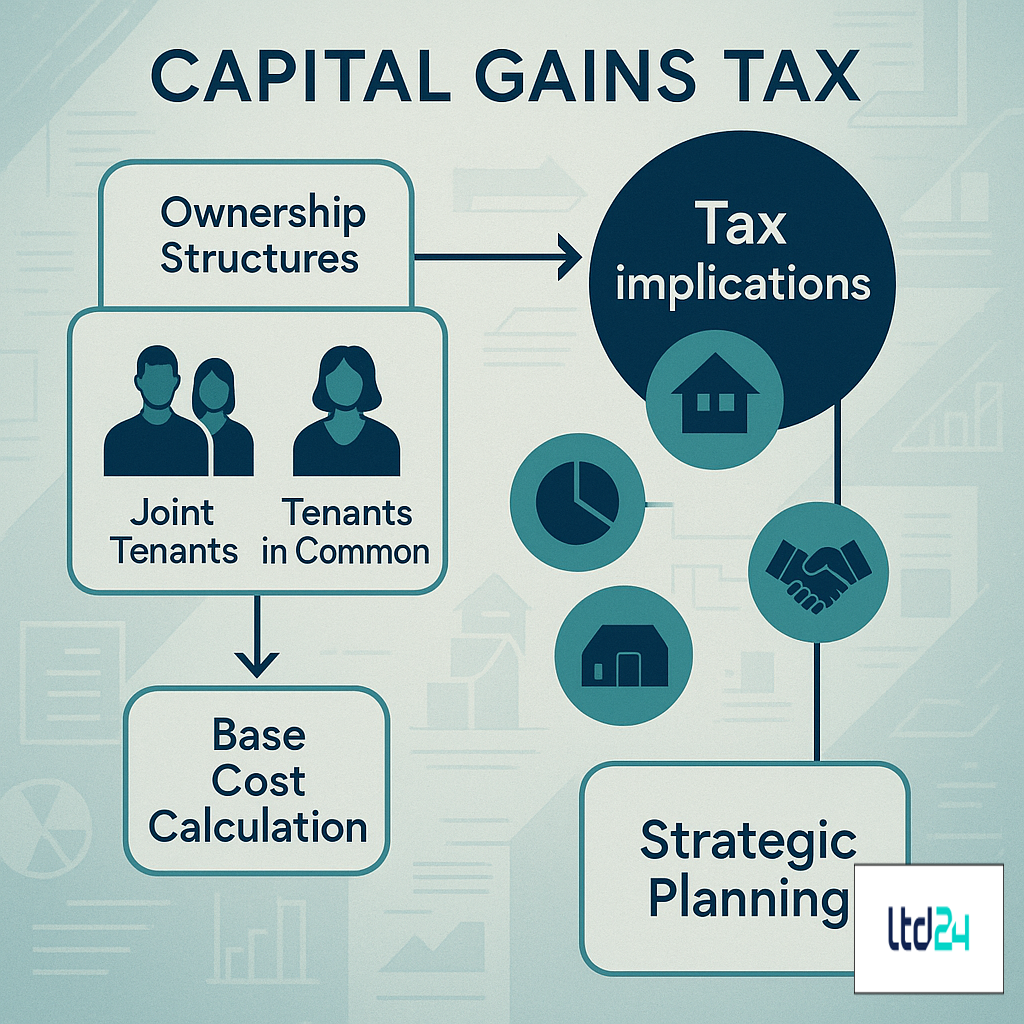
Capital Gains Tax (CGT) represents a significant consideration for property investors, business partners, and joint asset holders. When assets owned by multiple parties are sold at a profit, the taxation implications can become considerably complex compared to single-ownership scenarios. The core principle of CGT applies universally: tax is levied on the profit or ‘gain’ realized upon disposal of an asset that has increased in value. However, when multiple owners are involved, determining each owner’s tax liability requires careful analysis of ownership structures, percentage stakes, and acquisition circumstances. For property held jointly, business partnerships, or shared investment portfolios, understanding how CGT operates across different ownership arrangements is crucial for effective tax planning and compliance with HM Revenue & Customs (HMRC) regulations or similar tax authorities worldwide. Each co-owner must consider their individual tax position, available allowances, and potential reliefs when calculating their proportionate CGT liability.
Joint Ownership Structures and Tax Implications
Different ownership structures carry distinct tax consequences when calculating capital gains. Joint tenants hold equal, undivided interests in the property with rights of survivorship, meaning each owner’s share automatically transfers to surviving owners upon death without going through probate. In contrast, tenants in common can hold unequal shares, and each owner’s interest passes according to their will or intestacy rules. From a CGT perspective, the distinction is significant – joint tenants are typically treated as owning equal shares for tax purposes regardless of financial contributions, while tenants in common are taxed according to their documented ownership percentages. Similarly, formal partnerships, limited liability companies (LLCs), and other collective investment vehicles each follow specific tax treatment frameworks. Understanding these nuances is essential for proper tax planning, especially when owners have different income levels, tax residency statuses, or intentions for the proceeds of any asset disposal.
Calculation of Base Cost for Multiple Owners
Determining the base cost (also known as the acquisition value) forms the foundation of any CGT calculation, as it represents the starting point from which the taxable gain is measured. With multiple owners, establishing this figure becomes more nuanced. The acquisition value must account for the initial purchase price, eligible acquisition expenses such as legal fees and stamp duty, and any subsequent capital improvements that qualify for inclusion. When ownership stakes differ, or owners have joined at different times with varying entry costs, the base cost must be calculated individually for each owner’s portion. This can be particularly complex in scenarios where ownership percentages have changed over time, such as when a partner buys out another’s share or when new investors join an existing arrangement. Proper documentation of each owner’s contribution to the original purchase and any capital improvements is therefore essential. Consulting with a tax specialist becomes invaluable in accurately establishing these foundational figures that will ultimately determine the tax liability upon disposal.
Proportional Allocation of Capital Gains
When multiple owners sell an asset, the resulting capital gain must be allocated proportionally based on each owner’s legal interest in the property. For example, if three individuals own a commercial property as tenants in common with shares of 50%, 30%, and 20% respectively, and the property generates a total capital gain of £100,000, the first owner would recognize a £50,000 gain, the second £30,000, and the third £20,000. Each co-owner must then apply their own CGT annual exemption (currently £3,000 in the UK for the 2023/24 tax year, reduced from £12,300 in previous years) and calculate tax at their applicable rate based on their overall income status. The allocation becomes more complex with partnership interests, where the partnership agreement may specify profit-sharing ratios that differ from capital contribution percentages. Similarly, for jointly owned business assets, the articles of association or shareholders’ agreement may dictate how gains are distributed among owners, which might not align with the nominal shareholding percentages. Documentation of ownership proportions through formal agreements is therefore crucial for accurate tax reporting.
Special Considerations for Married Couples and Civil Partners
Married couples and civil partners benefit from distinct CGT treatment that can significantly impact tax planning strategies. Under UK tax law, transfers between spouses and civil partners occur on a no-gain, no-loss basis, meaning no CGT liability arises at the time of transfer regardless of the asset’s market value. This creates planning opportunities where assets can be transferred to utilize both partners’ annual exemptions or to take advantage of a lower-rate taxpayer’s status. However, the original acquisition cost transfers with the asset, preserving the potential gain for future disposal. For jointly owned property, the default assumption for married couples is 50:50 ownership unless evidence demonstrates otherwise, contrasting with the treatment of other co-owners where actual beneficial ownership must be established. Upon disposal, each spouse reports and pays tax on their share of the gain through their own Self Assessment tax return. These provisions create substantial planning opportunities for couples with significant assets, particularly when one partner has unused annual exemption amounts or falls into a lower tax bracket.
Impact of Different Tax Rates Among Co-Owners
Co-owners often face different CGT rates based on their individual income levels and tax circumstances, creating disparities in overall tax burden despite equal ownership interests. In the UK, basic rate taxpayers currently pay 10% on capital gains (excluding residential property), while higher and additional rate taxpayers pay 20%. For residential property not covered by private residence relief, these rates increase to 18% and 28% respectively. When multiple owners dispose of a jointly held asset, the tax impact can vary significantly—a basic-rate taxpayer might pay half the CGT rate of their higher-earning co-owner on an identical gain. This disparity creates both challenges and opportunities. Partners with varying income levels might consider restructuring ownership percentages to optimize the overall tax position of the group. Additionally, the timing of disposals can be strategically planned to coincide with tax years when certain co-owners might have lower income, thereby reducing their applicable CGT rate. International considerations add further complexity when co-owners are resident in different tax jurisdictions with varying CGT structures and bilateral tax treaties.
Annual Exemptions and Allowances for Each Owner
One of the primary advantages of multiple ownership for CGT purposes is that each owner can utilize their own annual tax-free allowance. Currently set at £3,000 per individual for the 2023/24 tax year in the UK (significantly reduced from previous years), this exemption applies to the total gains realized in a single tax year before CGT becomes payable. With four co-owners, for instance, up to £12,000 of collective gains could potentially be realized tax-free annually through strategic disposal planning. This benefit extends across different types of assets, allowing co-owners to potentially structure their investments to maximize the use of these allowances across their portfolio. However, timing is critical—the CGT exemption cannot be carried forward to future tax years if unused, making it important to plan disposals carefully. For business assets or investments held through structured vehicles such as companies or certain types of trusts, different rules may apply, potentially limiting the availability of individual allowances. Consequently, understanding how these annual exemptions interact with different ownership structures becomes a key element of effective tax planning.
Business Asset Disposal Relief (Formerly Entrepreneurs’ Relief)
For business owners and investors, Business Asset Disposal Relief (formerly known as Entrepreneurs’ Relief) offers a significant tax advantage by reducing the CGT rate to 10% on qualifying business disposals, subject to a lifetime limit of £1 million of gains. When multiple owners are involved, each qualifying individual can potentially claim this relief on their proportion of the gain, effectively multiplying the available relief across the ownership group. To qualify, each owner must meet specific conditions, including holding at least 5% of shares and voting rights in a company for a minimum of two years prior to disposal, or being a partner in a business partnership. With multiple owners, ensuring all parties maintain their qualifying status throughout the required holding period becomes a crucial planning consideration. This can be particularly challenging during business restructuring, when new investors join, or when ownership percentages change. The potential tax savings make it worthwhile to structure business ownership with this relief in mind from the outset, especially for startup businesses with multiple founders or family businesses with several stakeholders.
Private Residence Relief and Multiple Properties
Private Residence Relief (PRR) represents one of the most valuable CGT exemptions, particularly for property investors with multiple owners. This relief typically exempts gains on a property that has been the owner’s main residence throughout the period of ownership. The complexity arises when multiple owners have different residential statuses regarding the property—for instance, where one co-owner uses it as their main home while others treat it as an investment property. In such scenarios, each owner’s entitlement to PRR must be assessed individually based on their actual use of the property. Further complications emerge when co-owners have designated different properties as their main residences during the ownership period. The final nine months of ownership (reduced from 36 months in recent years) generally qualify for relief regardless of residency status, offering some planning flexibility. For married couples or civil partners, an additional constraint applies: they can only have one main residence between them for PRR purposes, unlike unrelated co-owners who can each potentially claim PRR on different properties. Understanding these nuances is vital for property investors with portfolios across multiple owners.
CGT Treatment for Business Partnerships
Business partnerships present unique CGT considerations as they operate with a hybrid legal status—while the partnership itself is not typically a taxable entity for CGT purposes, the disposal of partnership assets triggers individual tax consequences for each partner. When a partnership sells an asset, the resulting gain is allocated to partners according to their profit-sharing ratios rather than their capital contribution percentages, unless the partnership agreement specifies otherwise. This can create situations where partners who have invested different amounts receive disproportionate shares of the gain based on their agreed profit allocations. Additionally, when a partner exits a partnership, they effectively dispose of their partnership interest, potentially triggering a CGT event on their share of the underlying partnership assets’ appreciation. For partnerships with valuable business assets or property, succession planning becomes crucial to manage potential CGT liabilities. The availability of Business Asset Disposal Relief for qualifying partners can substantially reduce the tax impact, but careful structuring and timing of changes to the partnership composition is essential. Professional advice on partnership structures and agreements can help optimize the tax position for all partners across the business lifecycle.
CGT for Joint Investment Portfolios and Collective Investments
Joint investment portfolios and collective investment vehicles introduce another layer of complexity to CGT calculations for multiple owners. When investments are held in joint names, such as stocks, shares, or mutual funds, gains are typically split according to the beneficial ownership percentages. Unlike property, where legal title often clearly establishes ownership shares, investment portfolios require detailed records of each investor’s contributions and withdrawals to accurately determine tax liabilities. Collective investment schemes like unit trusts, open-ended investment companies (OEICs), and exchange-traded funds (ETFs) have their own CGT treatment, with gains typically flowing through to the individual investors based on their units or shares held. For sophisticated investors utilizing offshore investment structures, the tax implications become even more complex, potentially involving international tax considerations and reporting requirements. Strategic planning around the timing of investment disposals can allow multiple investors to utilize their annual exemptions efficiently across tax years. Married couples and civil partners can also transfer assets between them to optimize the use of available exemptions and lower tax rates before disposal.
Record Keeping Requirements for Multiple Owners
Comprehensive record-keeping is the foundation of effective CGT management for multiple owners. Each co-owner should maintain detailed documentation of their initial investment, subsequent contributions, and their share of any capital improvements or reinvestments. For jointly owned assets, particularly those held over many years, these records are vital for establishing an accurate base cost when disposal eventually occurs. Required documentation typically includes purchase contracts, conveyancing documents, partnership or shareholders’ agreements detailing ownership percentages, and receipts for any enhancement expenditure that can be added to the base cost. When ownership proportions change over time—through partial sales, gift transactions, or new investment rounds—these events must be meticulously documented to track each owner’s evolving cost basis. Digital record-keeping systems have become increasingly important for managing these complex ownership histories, particularly for investment portfolios with numerous transactions. Tax authorities typically require these records to be retained for a minimum period (generally at least six years in the UK), but for assets held long-term, preservation of acquisition documentation for the entire ownership period is essential.
International Considerations for Multiple Owners
When co-owners reside in different countries, the CGT implications become substantially more complex due to overlapping tax jurisdictions and varying international tax treaties. Each co-owner’s tax liability depends on their country of residence, domicile status, and the location of the asset, potentially resulting in different tax treatments for identical ownership interests. For example, a UK resident co-owner might pay UK CGT on their share of a gain from selling property located anywhere in the world, while a co-owner resident in another country might be subject to that country’s tax rules on the same transaction. To avoid double taxation, tax treaties between countries generally provide mechanisms for offsetting taxes paid in one jurisdiction against liabilities in another, but these provisions vary significantly between different bilateral agreements. For globally mobile individuals or international investment groups, careful planning around the timing of disposals can help minimize the overall tax burden. This might include considering temporary tax residency in jurisdictions with favorable CGT regimes or structuring ownership through entities in jurisdictions with beneficial tax treaties. The complexity of these arrangements often necessitates specialized international tax advice.
CGT Deferral Strategies for Multiple Owners
Several strategies exist for deferring CGT liabilities, which can be particularly valuable when coordinating disposal decisions among multiple owners with different financial circumstances and time horizons. Reinvestment relief opportunities such as the Enterprise Investment Scheme (EIS) allow qualifying individuals to defer CGT by reinvesting proceeds into eligible businesses. When multiple owners dispose of an asset, each can independently choose whether to utilize such reliefs based on their individual investment goals and tax situations. Similarly, holdover relief may be available for business assets or shares in qualifying scenarios, allowing the gain to be effectively passed to the recipient rather than triggering an immediate tax liability for the transferor. Timing strategies also play a crucial role—spreading disposals across different tax years can maximize the use of annual exemptions for each co-owner. For business assets, consideration of replacement property relief under certain conditions might allow for deferral of gains when proceeds are reinvested in similar qualifying assets. The availability of these strategies varies by jurisdiction and asset type, making it essential for co-owners to seek professional tax guidance when planning significant disposals.
Handling Disputes and Disagreements Among Co-Owners
Tax-related disagreements among co-owners can create significant complications, particularly when owners have divergent financial interests or tax positions. A common scenario occurs when one co-owner wishes to sell while others prefer to retain the asset, potentially creating forced CGT liabilities for all parties. Co-ownership agreements or shareholders’ agreements should ideally address decision-making protocols for asset disposals, including provisions for managing tax consequences. These agreements might include buy-sell provisions with predetermined valuation methods, first right of refusal clauses, or mechanisms for partial disposals that accommodate individual owners’ needs without forcing unwanted tax events on others. When disputes arise despite these preparations, mediation or legal intervention may become necessary. In extreme cases, court-ordered sales or partitioning of assets might occur, potentially creating suboptimal tax outcomes for all involved. For business partnerships or investment groups, regular review of exit planning strategies and tax alignment among members can help prevent such disputes. Additionally, corporate governance structures that clearly define authority for disposal decisions can mitigate potential conflicts while ensuring all owners’ tax interests are considered in the decision-making process.
Case Studies: Real-World Examples of Multiple Owner CGT Scenarios
To illustrate the practical application of CGT principles for multiple owners, consider these representative scenarios: In our first case study, three siblings inherited equal shares in a rental property valued at £300,000 at their parent’s death. After holding the property for eight years with a market appreciation to £480,000, one sibling needed to liquidate their interest. Rather than forcing a complete sale, they structured a buyout where the remaining siblings purchased the third’s share at current market value. This triggered a CGT event only for the departing sibling on their £60,000 gain (one-third of the total £180,000 appreciation), while the continuing owners increased their base cost for future CGT calculations. In another example, a technology startup with four equal shareholders sold to a larger company for £2 million, representing a gain of £1.8 million over their initial investment. Each shareholder utilized their Business Asset Disposal Relief allowance on their £450,000 gain, paying 10% CGT instead of the standard rate. One shareholder further deferred part of their liability by reinvesting in an EIS-qualifying venture. These examples demonstrate how understanding CGT rules for multiple owners enables strategic tax planning that respects individual financial needs while minimizing the collective tax burden.
Professional Guidance and Tax Planning for Multiple Owners
The complexity of CGT for multiple owners makes professional tax guidance not merely advisable but often essential for optimal outcomes. Engaging qualified tax advisors early in the ownership journey—ideally before acquisition—allows for strategic structuring that can significantly reduce eventual tax liabilities. For established ownership groups, regular tax planning reviews help adapt to changing personal circumstances, evolving business needs, and amendments to tax legislation. A comprehensive approach typically involves collaboration between tax specialists, legal advisors for ownership structuring, and financial planners addressing each owner’s broader wealth management goals. This multi-disciplinary perspective ensures that tax-efficient decisions align with commercial objectives and personal financial requirements. For international ownership groups, specialists in cross-border taxation can navigate the complexities of multiple tax jurisdictions. The cost of professional advice should be weighed against the potential tax savings and risk mitigation benefits, particularly for high-value assets or complex ownership structures. Many co-owners find that early investment in expert guidance delivers substantial returns through optimized tax positions and avoidance of costly compliance errors or missed relief opportunities. For personalized support with multiple-owner tax planning, Ltd24’s international tax consulting services provide tailored solutions to navigate these complex scenarios.
Tax Planning Strategies and Future Considerations
Effective CGT planning for multiple owners requires both immediate tactical decisions and long-term strategic vision. With the UK’s reduced annual exemption amount (£3,000 for 2023/24) and ongoing discussions about potential CGT rate increases, proactive management becomes even more critical. Co-owners should consider staggered disposal strategies that utilize each owner’s annual exemption across multiple tax years where practical. For appreciating assets, regular valuation reviews help identify optimal disposal timing before gains become excessively large. Family investment companies, trusts, and other structured vehicles can offer alternative approaches to managing collective investments with potential CGT advantages, though these must be balanced against other tax considerations and administrative requirements. Looking forward, anticipated legislative changes may impact available reliefs and rates, necessitating flexibility in planning. For instance, recent reductions in the Business Asset Disposal Relief lifetime limit from £10 million to £1 million demonstrate how reliefs can be significantly altered, affecting exit planning for business co-owners. Political and economic factors also influence CGT policy, with periodic calls for alignment of CGT rates with income tax rates potentially changing the planning landscape. Given these variables, multiple owners should develop scenario-based planning that can adapt to evolving tax frameworks while meeting their collective and individual financial objectives.
Navigating Your Complex Capital Gains Tax Scenario
Navigating capital gains tax with multiple owners requires specialized expertise, particularly when international elements or complex ownership structures are involved. The interaction of different tax rates, available exemptions, and varying personal circumstances among co-owners creates both challenges and opportunities for tax optimization. Strategic timing of disposals, careful structuring of ownership arrangements, and thorough documentation of all transactions form the foundation of effective CGT management across ownership groups.
If you’re facing decisions about jointly owned assets with potential tax implications, expert guidance can make a significant difference to your outcomes. Our team at Ltd24 specializes in international tax consulting with particular expertise in multiple-owner scenarios across different jurisdictions.
We are a boutique international tax consultancy with advanced expertise in corporate law, tax risk management, asset protection, and international audits. We offer tailored solutions for entrepreneurs, professionals, and corporate groups operating globally.
Book a session with one of our experts now at $199 USD/hour and get concrete answers to your tax and corporate questions: https://ltd24.co.uk/consulting.

Alessandro is a Tax Consultant and Managing Director at 24 Tax and Consulting, specialising in international taxation and corporate compliance. He is a registered member of the Association of Accounting Technicians (AAT) in the UK. Alessandro is passionate about helping businesses navigate cross-border tax regulations efficiently and transparently. Outside of work, he enjoys playing tennis and padel and is committed to maintaining a healthy and active lifestyle.


Comments are closed.